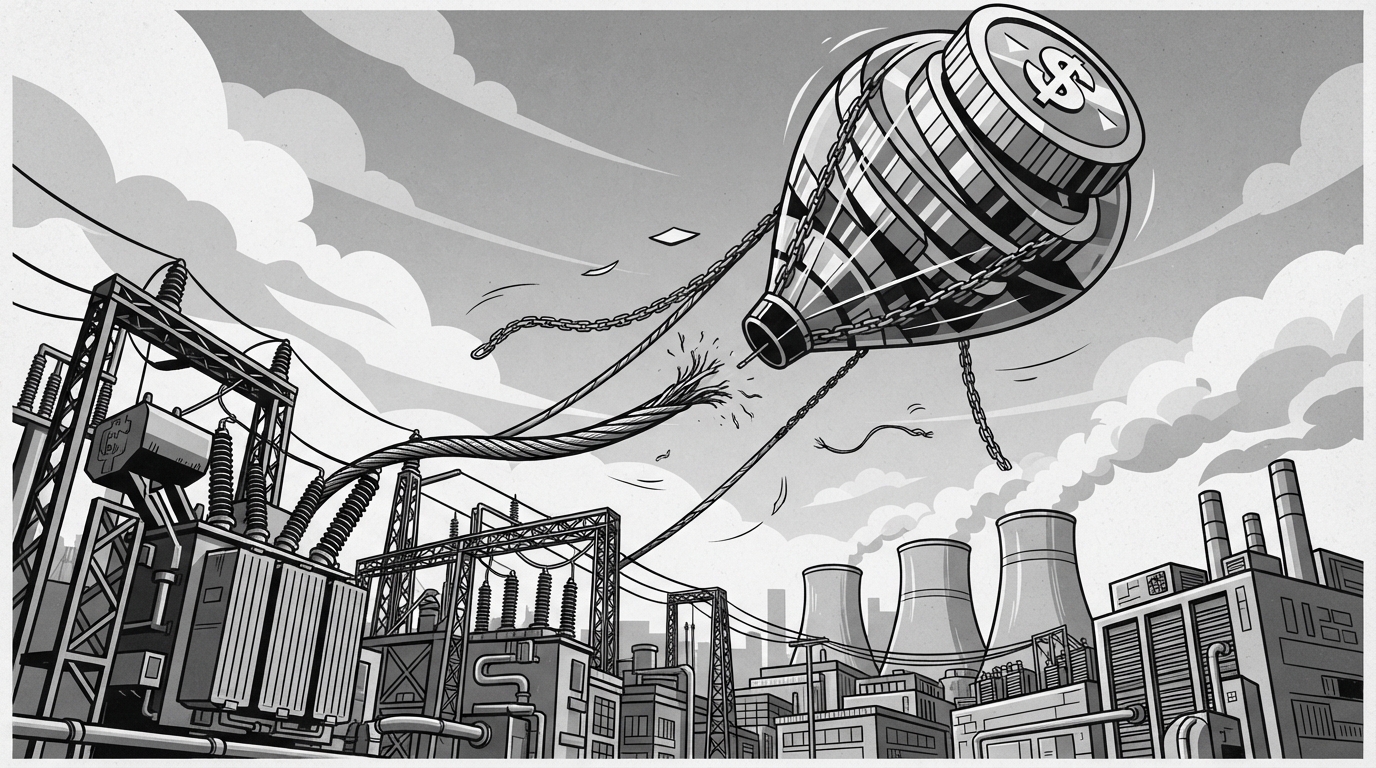
The AI economy is straining against its own scale today. OpenAI is reportedly holding out for a valuation above $1.5 trillion, Instinct's price tag quadrupled in under a month, and SoftBank's default-risk gauge hit a three-year high on OpenAI exposure — signals of a funding frenzy detached from any historical yardstick. Underneath the deals runs a physical crunch: Anthropic locked in 2.16 GW in Australia, data-center power demand is set to jump 31%, and a memory-chip shortage projected to last into 2027 is sending RTX 5090 prices to $9,000. Open models keep charging ahead, with Alibaba's Qwen3.8-27B topping Hugging Face and Mozilla pegging the US-China capability gap at just 4.4 months. And policymakers are pushing back — the EU banned under-13s from social media and von der Leyen backed an AI slowdown — even as leaked queries stoke bioweapon fears at the technology's darker edge.
Investors reportedly approached OpenAI at a $1.2 trillion valuation, but the company believes it should command at least $1.5 trillion. The roughly $300 billion standoff shows how AI-boom economics have detached from any historical yardstick, with a single private firm negotiating over sums that rival the market caps of the world's largest public companies — and the final price will set a reference point for the entire AI funding landscape.
Open models are having a moment: Alibaba's Qwen3.8-27B became the most-downloaded open-weight model in Hugging Face history, iFlytek trained a 99-language audio model entirely on domestic compute, and Mozilla put the US-China capability gap at just 4.4 months. The next frontier is stirring too, with GPT-6 Sol and Claude Opus 5.2 spotted in grayscale testing and Claude shipping 43 workflows across 27 apps. Agents are moving into the real world — Salesforce built one for the TSA, vivo unveiled an on-device model matrix — while a memory shortage into 2027 and $9,000 RTX 5090s show the hardware layer buckling under demand.
The ledger is dominated by AI dealmaking and the cost of building it out. Instinct is raising at a $10 billion valuation, up from $2.25 billion less than a month ago, while SoftBank's CDS hit a three-year high on OpenAI concerns and Oracle added $700 million to its AI transformation bill. ByteDance drug-discovery spinoff Anew Labs raised $290 million at a $1.5 billion valuation. Powering all of it is a surge in demand for electricity: TrendForce projects data-center power consumption up 31% year-on-year, and Hong Kong's data-center ambitions face a $2.6 billion funding test.
Geopolitics increasingly turns on AI and chips. Commission president von der Leyen backed an AI slowdown in her State of the Union, the EU floated Canada as its first "associate member," and Washington and Beijing weighed tariff cuts ahead of a leaders' summit — with Nvidia's Jensen Huang set to join a Trump-Xi dinner, underscoring that silicon sits at the center of diplomacy. China's defense minister urged tougher global AI oversight, even as a WSJ report detailed a Chinese firm using AI to supercharge cyber-espionage and leaked AI queries stoked fears of a new bioweapons race.
The human edges of AI are as telling as the headline deals. A Deloitte survey found UK workers self-funding nearly £1 billion of workplace AI, a stark measure of "shadow AI" adoption, while a viral post reignited debate over dropping mandatory English in China's schools as translation improves. Germany's Rheinmetall surprised observers by open-sourcing its connected-weapons protocol, a Texas police department was ordered disbanded for serving no community benefit, and one gamer coaxed a 50% frame-rate boost from Resident Evil 7 using DeepSeek. Hollywood frets about an AI future while China's film industry embraces it.


